Cast the right people on every brief, through pitches, shoots, freelancers and review rounds, and see the margin before you commit. Kavaro is resource planning built for creative studios. It shows who's free, who's held for a pitch and who's out on a shoot, and it tells you what each brief will earn once it's staffed.
Start your 30-day free trial: no card needed · See pricing
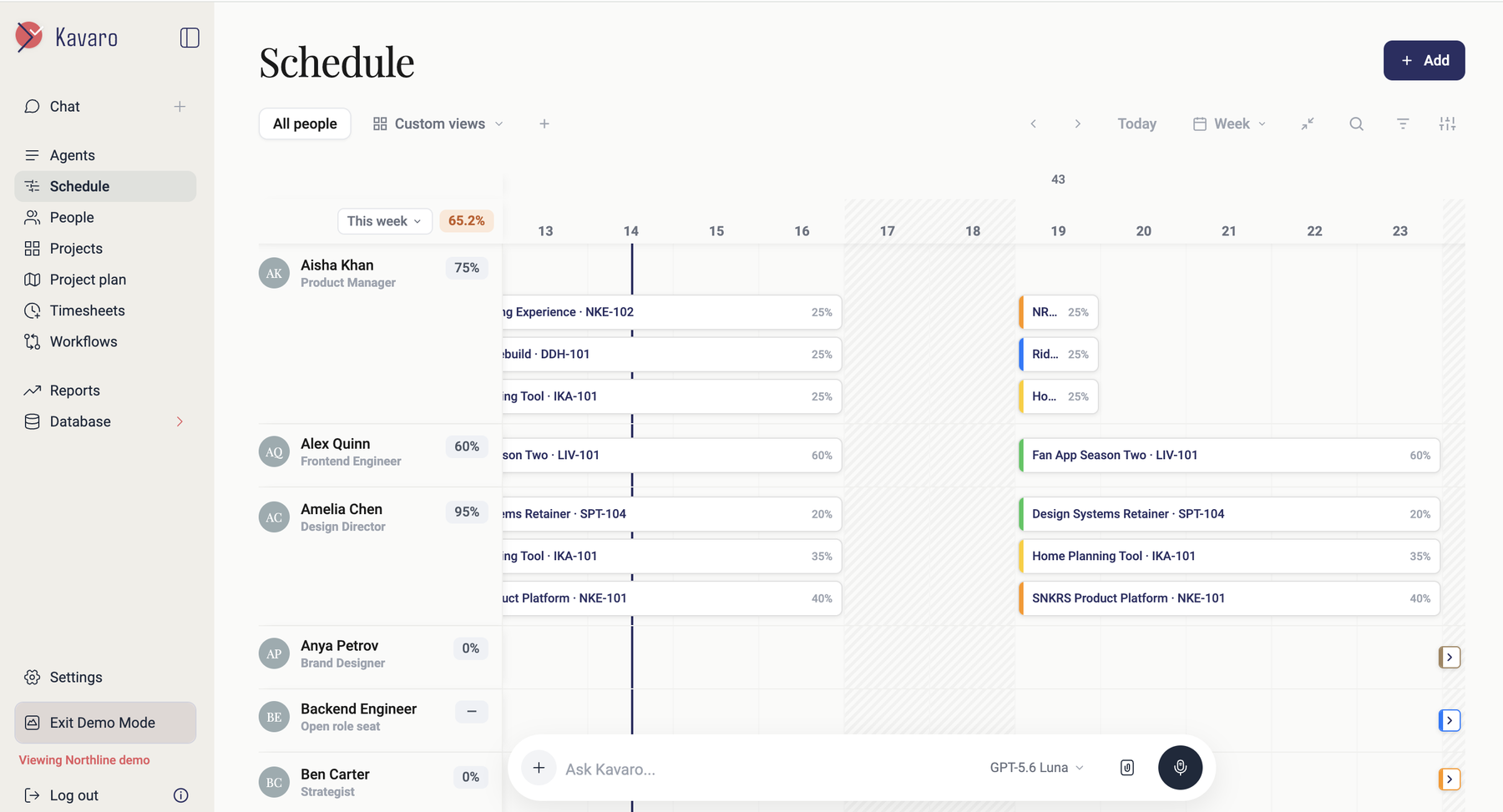
Creative resourcing is a moving feast
Creative work doesn't stay where you put it. Briefs change, clients go quiet and then all reply at once, and the best concept needs the one designer who's already booked. In our research interviews, the people who staff creative teams described it like this:
- "The design stuff is very sort of movable feast. It moves from day to day." Resource manager, creative agency.
- "A shoot will take you out of the business for a couple of weeks." The same resource manager, on why production has to be planned weeks ahead.
- "Somebody gets ill, like the client is late, you know, the internal QA happens, then you have to redo something." Head of delivery, ~120-person agency.
- "All pretty much TBC from a resource standpoint." The same head of delivery, on pre-sale work at 30% likelihood.
- "It's very pitch heavy … lots of failed pitches and just chaos really." A design operations lead, on a previous agency.
Creative agencies don't need another task board. They need to see the week as it really is: confirmed work, pitch work that might land, shoots, freelancers and leave, all in one place. Then they need to make the casting call quickly.
What "creative agency software" covers, and where Kavaro fits
People searching for creative agency software usually mean one of three things:
| Type | What it runs | Examples |
|---|---|---|
| All-in-one agency management (PSA) | Quotes, projects, time, budgets, invoicing and resourcing in one system | Scoro, Productive, Ravetree |
| Project management for client work | Tasks, timelines, client collaboration, time tracking, sometimes invoicing | Teamwork.com, Paymo |
| Resource planning and scheduling | Who works on what and when, capacity, utilisation | Float, Resource Guru, Kavaro |
Kavaro sits in the third group, with two differences. It puts margin on every booking, and it uses AI to draft the plan from your briefs while your team confirms every change. If you need invoicing or task boards too, Kavaro works next to the tools you already use (Jira and Trello sidebars, webhooks to Zapier or Make) rather than replacing them.
How Kavaro works for creative studios
Cast from skills, not just job titles
Upload CVs and Kavaro drafts each person's profile with their skills. People carry roles, skills, domains, industries and languages, so you can ask chat "who has motion design and time in the next three weeks?" and get an answer from your own data. Casting stays your call, and the information is in front of you when you make it.
Hold pitch work without losing confirmed work
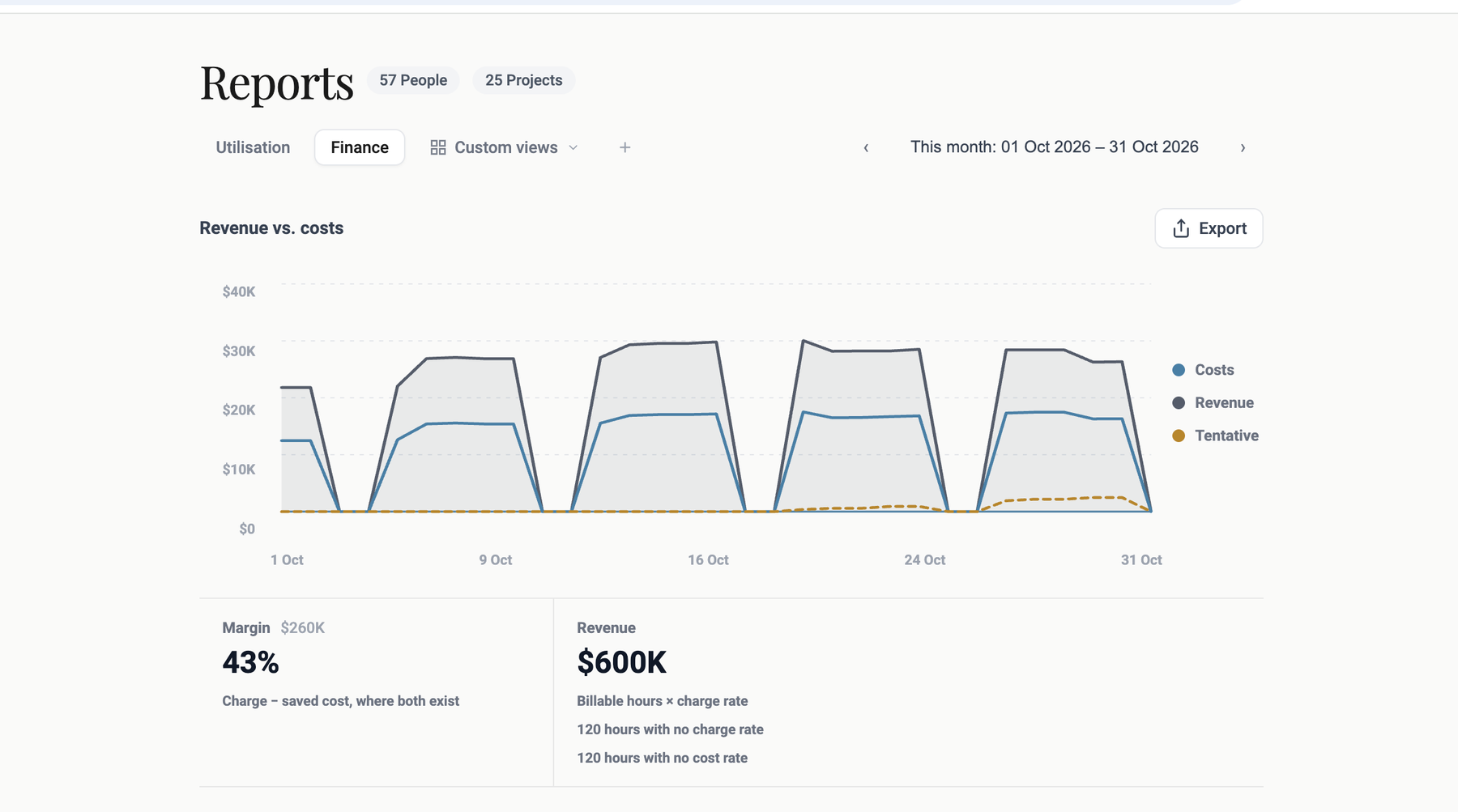
Book pitches and likely wins as tentative and tag how firm they are: Pitch, Opportunity, Estimate or Tentative. Tentative work shows as striped bars on the schedule. Its revenue stays out of confirmed numbers in the finance view, so a busy pitch month doesn't make the studio look more profitable than it is. When the work lands, switch the holds to confirmed. When it doesn't, remove them and the time frees up.
Plan shoots, edits and production days
Shoots don't follow the working week. Bookings can run across weekends and non-working days when a shoot does. Time off sits on the same schedule as project work, so you see clashes before the call sheet goes out. Crew and creative seats you haven't filled yet appear as open roles with their own rows.
Put freelancers in the plan, with their real cost
Add freelancers to the roster with their own cost rate, so their bookings carry real cost and your margin stays honest. For any open role, Kavaro's hiring view ranks your options:
- Same-role cover from inside the studio.
- A start slip of up to 10 working days.
- Partial internal cover with a freelancer for the gap.
- Extending a contract that ends shortly before the role starts.
Each option is costed against what the role earns, and when nobody covers the role fully, a freelance line is added for comparison.
Run retainers next to project work
Set a client's retainer as a project with the Retainer budget type and a budget total, then book the retainer team week by week alongside campaigns and one-off projects. Finance shows revenue, cost and margin per client, so an over-serviced retainer shows up before the month closes.
Keep up when dates move
When a client is late or a round of feedback adds a week, move the booking and everyone affected sees it. Paste in your status-meeting notes and Kavaro proposes the booking changes that came out of the meeting, for you to confirm or reject. Every Monday you can also get a RAID log for a project you choose, flagging over-booked people, leave during bookings, unfilled roles and phase deadlines for the next four weeks.
Worked example: a won pitch becomes an eight-week rebrand
Names and rates in this example are illustrative.
A 15-person studio pitches for a rebrand. During the pitch, the identity lead, a copywriter and a motion designer are held as tentative for weeks 3–10. The pitch is won.
- Confirm the work. Upload the signed statement of work. Kavaro drafts the project's phases (strategy, identity, rollout) and team for you to check and confirm. Then switch the pitch holds from tentative to confirmed.
- Spot the clash. The studio's motion designer is now booked on a campaign shoot in weeks 6–7, the same weeks the rebrand needs 10 days of motion work.
- Compare the options. The motion seat is worth £8,000 (10 days at a £800 day rate). The hiring view costs each way of covering it:
| Option | How it's covered | Cost | Margin on the seat |
|---|---|---|---|
| A. Slip the motion phase one week | In-house motion designer covers all 10 days at a £380/day cost | £3,800 | £4,200 (53%) |
| B. Split it | 6 days in-house, 4 days with a freelancer at £500/day | £4,280 | £3,720 (47%) |
| C. Freelancer for the whole seat | 10 days at £500 | £5,000 | £3,000 (38%) |
- Make the call. If the client's rollout date can't move, option B keeps the date and gives up £480 of margin compared with A. You decide before the client asks, not after the shoot overruns.
Benchmark: how much a creative studio can really sell
Creative agencies sell less of their time than other agency types. Planning to a target your studio can't hit is how margins disappear. These ranges use published UK benchmarks for creative agencies (brand, design, advertising), applied to studios of different sizes.
| Studio size | Available hours per week (after UK statutory leave) | Billable hours per week at the creative benchmark (60–70%) |
|---|---|---|
| 8 people | ~270 | 160–190 |
| 15 people | ~500 | 300–350 |
| 30 people | ~1,000 | 600–700 |
| 60 people | ~2,010 | 1,200–1,400 |
How to read it
- Agency-type benchmark (measured, published). UK creative agencies typically run at 60–70% billable utilisation, against 65–75% for digital and SEO agencies and 70–80% for PPC (Alto Accounting, citing the BenchPress survey of UK agencies and Synergist).
- Roles inside the studio (measured, published). Directors run at 30–40% and junior and delivery staff at 70–80% (same source).
- Warning signs. A delivery team consistently above 85% is a burnout risk. Below 60% means capacity you're paying for but not selling.
- Available hours (estimated). A 37.5-hour week less the UK statutory 28 days' leave (GOV.UK) gives about 33.5 hours a week averaged over the year. Pitch time, sickness and training aren't taken off, so treat these as ceilings.
Check your own studio's rate with the free billable utilisation calculator, and total a month's invoiceable time across the team with the billable hours calculator. Setting studio rates? Use the free agency rate card template.
Resource planning for every kind of creative studio
Brand, identity and strategy agencies
Long strategy phases lead into intense identity production, often with scarce senior time in workshops. Plan the strategy team and the design team as separate phases of one project, so you can see who's free before you sell the next identity.
Rebranding agencies
Rebrands roll out in waves across strategy, identity and rollout. Phases with their own dates and team show who is booked before the next workstream starts.
Design and graphic design studios
Retainer design work and campaign rushes compete for the same designers. Utilisation by person shows who is overallocated before the next rush job lands.
Digital creative and web design agencies
Design and build share developers across sites, campaigns and product work. One schedule across every project shows who's shared and where the launch window is tight.
UX/UI and product design agencies
Research, prototyping and handoff need specialists at different points. Skills on each profile and open roles for the seats you still need make the discovery sprint easier to staff.
Copy and naming agencies
Work comes in short, intense bursts with review bottlenecks. The weekly bench card shows who has space for the next shortlist.
Video and production companies
Shoot days, edit suites and freelancer availability decide the schedule. Bookings across non-working days, open crew roles and freelancer costs keep the production plan and its margin together.
For marketing, advertising, PR, SEO and social agencies, see agency resource management software.
Creative agency software compared
These are the tools that come up most when creative agencies shortlist software. The table records what each one is and its list price on the vendor's page on 19 October 2026, unless a third-party source is noted. Prices change, so check before you buy.
| Tool | Type | Entry price (per user/month) | Free trial | Good fit for |
|---|---|---|---|---|
| Kavaro | Resource planning + margin, with AI | £15 billed annually, £18 monthly | 30 days, no card | Studios whose hard problem is casting, pitches, freelancers and margin |
| Float | Resource scheduling | $7 (Starter), $12 (Pro, adds time tracking and rate cards) | 30 days, no card | Studios that want a mature, visual scheduler |
| Resource Guru | Resource scheduling | $5 (Grasshopper, no reports), $8 (Blackbelt) | 30 days | Low-cost booking of people, rooms and equipment |
| Productive | All-in-one agency platform | $10–12 (Essential), $25–29 (Professional) | 14 days, no card | Agencies that want projects, budgets, billing and resourcing in one system |
| Scoro | All-in-one agency management | $26 annually, $28 monthly (Essential); 5-user minimum* | 14 days, no card* | Agencies that want quotes, projects and finance in one place |
| Teamwork.com | Project management for client work | Free up to 5 users; $9.99 (Basics, min. 3); $24.99 (Accelerate, min. 5), billed annually | 14 days, no card | Teams that run client delivery as tasks and timelines |
| Paymo | Project management, time tracking, invoicing | $5.90 annually / $9.90 monthly (Solo); $10.90 / $15.90 (Plus) | Free plan available | Small studios that want tasks, timesheets and invoices in one low-cost tool |
| Ravetree | All-in-one agency work management | $29 annually ($348/yr), $39 monthly** | Free trial (length not stated) | Agencies that want projects, resourcing, time, billing and CRM together |
* Scoro figures from Agiled's May 2026 Scoro pricing review, not Scoro's own page.
** Ravetree figures from its G2 pricing listing; G2 notes the pricing information was last updated October 2024.
One honest note: Kavaro is new and doesn't yet have the review history the others have on G2 and Capterra. That's why the trial is 30 days and needs no card. If you need invoicing and task management in the same tool, an all-in-one platform may suit you better. If your hard problem is who does the work and what it earns, that's what Kavaro is built for.
Detailed comparison: Kavaro vs Productive. Also: Paprika software alternative · Teamwork.com alternative.
"Isn't a spreadsheet enough?"
Sometimes it is. One creative resource manager told us: "sometimes we're overcomplicating the simplest of tasks by making a shiny new object, when in fact, you know, a spreadsheet does the job." For a small studio with one person owning the plan, a sheet can work. It stops working when:
- More than one producer books people, and changes collide.
- Pitch holds need to sit next to confirmed work.
- Freelancer costs and day rates need to show up in margin.
- Leave lives in one system and bookings in another.
Switching worry? Start from what you already have. Upload CVs to create people and SoWs to create projects, check each draft, then confirm. A seeded demo and step-by-step tours let you try every page before you add your own studio.
Pricing
Kavaro costs £15 per user per month billed annually, or £18 monthly, with a 30-day free trial and no card required.
| Studio | Annual billing | Monthly billing |
|---|---|---|
| 15 people | £225/month (£2,700 a year) | £270/month |
| 40 people | £600/month (£7,200 a year) | £720/month |
Prices exclude VAT where it applies. See full pricing.
Frequently asked questions
What is creative agency software?
Creative agency software is the set of tools a creative studio uses to run its work. That can mean all-in-one agency management (quotes, projects, time, billing), project management for client work, or resource planning that decides who works on what. Kavaro is resource planning, with margin on every booking and AI that drafts plans from your briefs.
What is the best creative agency software?
It depends on your hardest problem. If you want one system for quotes, projects and invoicing, look at all-in-one platforms such as Scoro, Productive or Ravetree. If you run delivery as tasks, look at Teamwork.com or Paymo. If your problem is casting, pitches, freelancers and protecting margin, a resource planning tool such as Kavaro, Float or Resource Guru is the better fit.
What is creative resource management?
Creative resource management is deciding which designers, writers, producers and freelancers work on which briefs and when. It balances confirmed work, pitches and leave so the studio delivers on time without burning people out or losing margin.
How should a creative agency plan for pitches?
Hold the people a pitch will need as tentative bookings and tag them as Pitch, so they don't overwrite confirmed work. Keep pitch revenue out of confirmed numbers until the work is won, then switch the holds to confirmed.
How do you include freelancers in a resource plan?
Add each freelancer to the roster with their own cost rate, so their bookings carry real cost. For unfilled seats, compare freelance cover with internal options on cost and margin before you book.
What utilisation rate should a creative agency target?
Published UK benchmarks put creative agencies at 60–70% billable utilisation. Directors typically run at 30–40% and delivery staff at 70–80%. A delivery team consistently above 85% is a burnout risk.
How much does creative agency software cost?
List prices on 19 October 2026 ranged from free (Teamwork.com up to 5 users, and Paymo's free plan) to about $29–39 per user per month for all-in-one platforms. Kavaro is £15 per user per month billed annually, or £18 monthly.
Related: Agency resource management software · Resource management for consultancies · Kavaro vs Productive · Paprika software alternative · Teamwork.com alternative · Billable utilisation calculator · Billable hours calculator · Pricing