Keep consultants billable, staff engagements by skill, and see the bench before it costs you. Kavaro is resource planning for consultancies. It shows billable and non-billable time, who rolls off when, and what every engagement earns at your rate cards.
Start your 30-day free trial: no card needed · See pricing
Busy isn't the same as billable
A consultancy sells time and expertise, so the resourcing questions are sharp ones. Is this consultant billable or just busy? Who rolls off in three weeks? Who has the skills the next engagement needs? In our research interviews, people running resourcing and finance at consultancies put it like this:
- "What we don't do very well currently is utilization versus billable hours … someone's occupied, but are they billable?" Finance lead, consultancy.
- "Resourcing is an art as much as it is a science, but it really relies on you knowing … the skills of every[one]." The same consultancy. They added that if that person goes on leave or leaves, "there's a really big gap."
- "If I have somebody who's over utilized and I have somebody who's underutilized … can I help this person from burnout and help this person simultaneously." Resource manager, global consultancy.
- "The frustration, the degree of maintenance of an Excel and the ease with which mistakes are made." Resourcing lead, consultancy, on why they bought a system.
- "It's not just who you have on the bench. It's allocating the right skills to the right projects." Operations lead.
What consulting resource management software does
Consulting resource management software plans which consultants work on which engagements, and when. It tracks capacity, billable utilisation, bench time and skills, so the firm can staff work profitably without overloading its best people.
It differs from the other tools a consultancy runs:
| Tool | What it answers | Typical owner |
|---|---|---|
| Project management | Are the tasks on this engagement on track? | Engagement or project manager |
| Resource management | Who should work on what, when, and are they billable? | Resource manager, operations, finance |
| PSA (professional services automation) | Everything from pipeline to invoice in one suite, including resourcing | Operations and finance, often after a long implementation |
Kavaro is resource management. It works alongside your finance and project tools rather than replacing them.
How Kavaro works for consultancies
Billable utilisation, not just "booked"
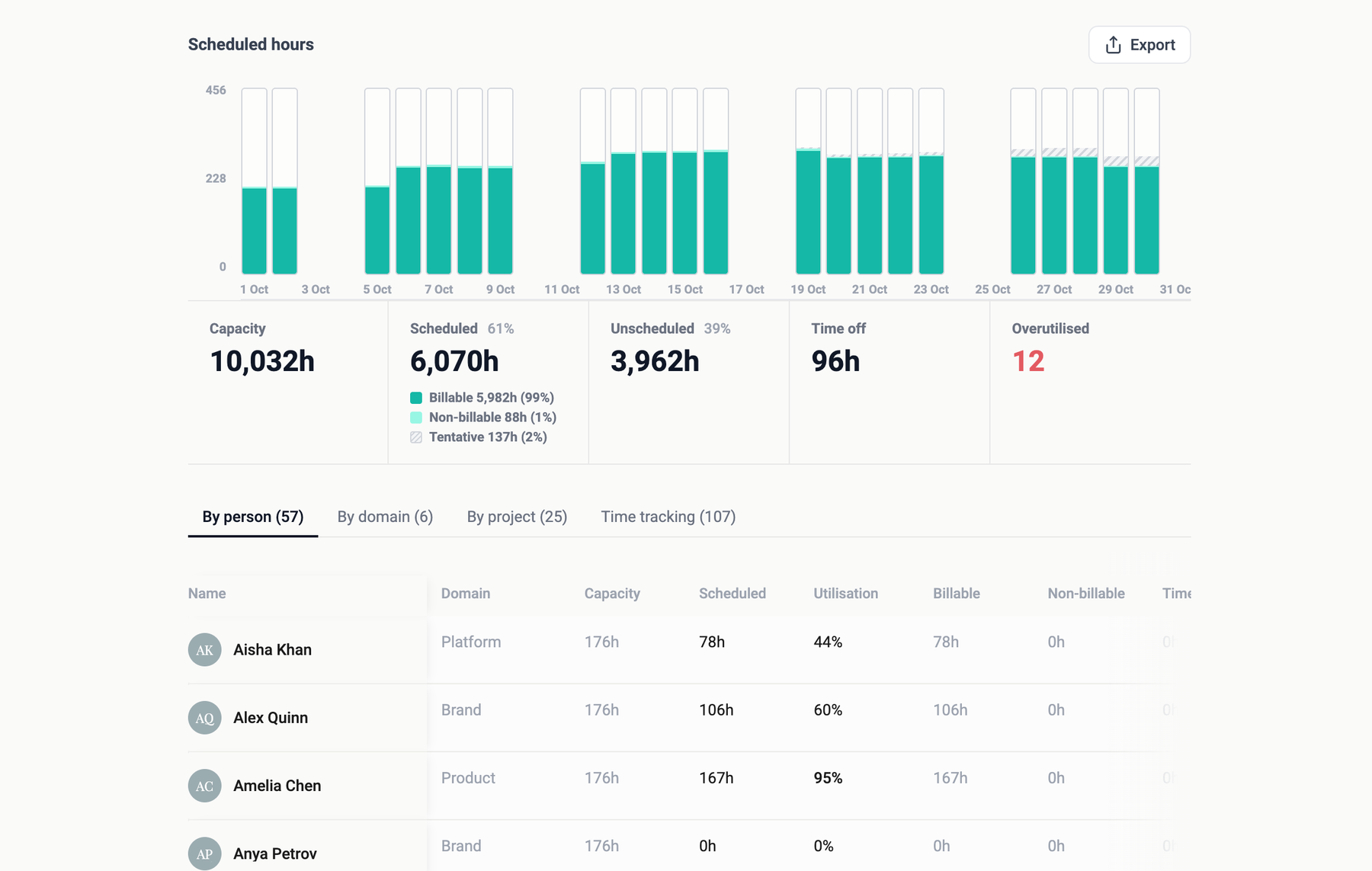
Every project carries a billability setting and a pricing model (time and materials, fixed fee, fixed hours, retainer or no budget). Kavaro's utilisation report splits each person's time into billable and non-billable, by week, person, domain and project. You see who is occupied but not billable, the exact gap the finance lead above described. Export to Excel or PDF, or, as an admin, describe the chart you want ("billable vs non-billable by week for the strategy team") and Kavaro builds it.
The bench, every Monday
Kavaro's weekly feed shows the bench: people with capacity and no booked hours that week, after time off. Partly booked consultants show as under-utilised. Open roles, meaning seats on an engagement with no one assigned, show as revenue at risk rather than revenue. You see roll-offs and gaps before they become lost weeks.
Staff by skill, starting from CVs
Upload consultants' CVs and Kavaro drafts each profile with their skills. People carry roles, skills, domains, industries and languages. Ask "who has public-sector procurement experience and is free from March?" and Kavaro answers from your own records. Upload the statement of work for a new engagement and Kavaro drafts the phases, team and tentative bookings. Seats you can't fill yet become open roles.
Rate cards and margin on every engagement
Rate cards sit on the client or the engagement. Each booking takes its charge rate from the card. Each consultant's cost rate is saved onto the booking when they're added, with a history of rate changes for anyone with finance access. Finance reporting shows revenue, cost and margin for the period. Hours with no charge or cost rate are flagged rather than counted as zero.
Pipeline, forecasting and the hire-or-not decision
Engagements move through stages from Opportunity to Lost. Likely work can be held as tentative and tagged by firmness: Tentative, Pitch, Opportunity or Estimate. Kavaro's hiring view looks 4, 8 and 12 weeks ahead at every unfilled seat and ranks the ways to cover it:
- Same-role consultants with space.
- A start slip of up to 10 working days.
- Partial cover.
- Extending a contractor whose contract ends shortly before the seat starts.
- A freelance line when nobody covers it fully.
It then runs a 12-month test of whether one permanent hire would cover their cost.
Timesheets that match the plan
Booked hours appear as timesheet suggestions that consultants log in one click. Every Monday the feed lists who hasn't started last week's timesheet and who logged under 90% of their expected hours, by name.
Governance your IT team will ask about
- Sign-in with Google, email two-factor authentication, domain sign-in restriction, and SAML single sign-on (Entra ID, Okta, OneLogin).
- Finance fields (budgets, rates, margin) are visible only to people with finance permission.
- Kavaro's AI never changes the plan on its own. It proposes changes you Confirm or Reject.
- Connect Claude or ChatGPT to Kavaro and the same permissions apply, with finance fields removed for people without access.
- Our Data Processing Agreement and subprocessor list are on Security & GDPR.
Benchmark: what one point of utilisation is worth
The latest SPI Research benchmark found professional services billable utilisation fell to 66.4% in 2025, the lowest in the survey's history, against a 75% target. On-time delivery held at 73.8%, project margin rose to 37.7%, and revenue per billable consultant reached $210K (SPI Research 2026, 500+ firms, via Deltek).
So what is closing that gap worth to your firm? One percentage point of utilisation is about 17 billable hours per consultant per year: 1% of the ~1,740 hours left after UK statutory leave.
Per consultant, per point of utilisation
| Average day rate | Value of +1 point, per consultant per year |
|---|---|
| £600 | ~£1,390 |
| £900 | ~£2,090 |
| £1,200 | ~£2,780 |
Per firm, at a £900 average day rate
| Billable consultants | Value of +1 point a year | Value of closing the gap from 66.4% to 75% (8.6 points) |
|---|---|---|
| 20 | ~£42,000 | ~£359,000 |
| 50 | ~£104,000 | ~£898,000 |
| 100 | ~£209,000 | ~£1.8m |
How to read it
- Benchmark figures (measured, published). SPI Research, via Deltek.
- Available hours (measured inputs, computed result). A 37.5-hour week less the 28 days' statutory leave (GOV.UK) leaves 1,740 hours. Sickness, training and business development aren't taken off.
- Day rates (assumed). These are illustrative. The tables also assume every extra billable hour can be sold at that rate, which only holds when there is demand for it. Treat the results as the upper bound of what better resourcing can recover.
- Role targets (measured, published). In UK agencies and consultancies, directors typically run at 30–40% and delivery staff at 70–80% (Alto Accounting, citing BenchPress and Synergist). Above 85% across a delivery team is a burnout risk.
Work out your own utilisation with the free billable utilisation calculator, then set role rates and a blended team rate with the consultancy rate calculator. Staffing a new engagement? The free project staffing plan template plans roles by week from the SOW, and the agency rate card template prices the team mix.
Worked example: two consultants roll off as a new engagement lands
Names and rates in this example are illustrative.
A 50-person consultancy has a 12-week engagement at Opportunity stage. It needs a senior data consultant four days a week (48 days), charged at £1,000 a day: £48,000.
- Monday feed. The bench card shows two consultants rolling off in three weeks with nothing booked after. Left alone, one of them costs about £6,000 over three weeks of bench at a £400/day cost, with no revenue.
- Draft the engagement. Upload the statement of work. Kavaro drafts the phases and team, with the senior seat as an open role held as tentative.
- Compare the options. The hiring view ranks the ways to cover the seat:
| Option | How it's covered | Cost | Margin on the seat |
|---|---|---|---|
| A. Staff from the bench | A rolling-off consultant with the right skills, at a £400/day cost, starting one week later | £19,200 | £28,800 (60%) |
| B. Extend a contractor | A contractor whose contract ends two weeks before, extended at £650/day | £31,200 | £16,800 (35%) |
| C. New freelancer | 48 days at £750/day | £36,000 | £12,000 (25%) |
- Make the call. Option A keeps the most margin and takes a consultant off the bench. Its cost is a one-week later start, so the conversation with the client happens before the engagement is signed, not after.
Built for every kind of consultancy
Management and strategy consultancies
Small senior teams, high day rates and long sales cycles. Utilisation by role keeps partners and directors at realistic targets while delivery staff stay billable. Tentative pipeline work shows the staffing you'd need before the proposal goes out.
Technology and digital consultancies
Specialists move between delivery teams and context-switch across engagements. Skills on every profile and open roles for unfilled seats make it easier to staff a kickoff. Jira and Trello sidebars sit next to the schedule if your delivery teams live there.
In-house and public-sector consulting teams
Internal teams still need to show utilisation and recover cost. Billable and non-billable splits, rate cards per internal client, and Excel export give finance the numbers without a monthly rebuild.
For agencies, see agency resource management software. For creative studios, see creative agency software.
How Kavaro compares with other consulting tools
| Kavaro | Enterprise PSA suites (e.g. Kantata, Deltek, Certinia) | Firm-specific scheduling (e.g. Dayshape) | Lightweight schedulers (e.g. Float, Resource Guru) | |
|---|---|---|---|---|
| Scope | Resource management: utilisation, bench, skills, rate cards, margin | Pipeline to invoice, including resourcing | Scheduling for accounting, audit, tax and advisory firms | Scheduling and capacity |
| Price | £15/user/month annually, £18 monthly | Kantata: on request (others not checked) | On request | Float from $7, Resource Guru from $5 per person per month |
| Trial | 30 days, no card | Varies by vendor | No free trial listed | 30 days |
| Set-up | Start from CVs and SoWs, confirm each draft | Measured in months. Deltek cites about 11 months for one consulting firm's move to Vantagepoint | Not published | Self-serve |
| Best for | Consultancies that want billable utilisation, bench and margin without a suite rollout | Large firms replacing finance, project and resourcing systems at once | Big Four-style firms with audit and tax scheduling needs | Teams that only need a visual schedule |
Prices and trials checked on 19 October 2026. Kavaro is new and has no review-site ratings yet, so try it on your own data for 30 days before deciding. Full comparison: Kantata alternative.
Spreadsheet or system?
A spreadsheet works while one person owns the plan and the firm is small. It breaks when several engagement leads book the same people, when finance needs billable utilisation and margin by engagement every month, and when skills live in a separate CV library. Every reconciliation is manual.
Worried about adoption? One transformation lead listed what matters when bringing in a system: "Accuracy of data, making sure it's set up properly, adoption by teams, making sure the training's in place." Kavaro starts from documents you already have, such as CVs and statements of work, and every AI change waits for a person to confirm it. Step-by-step tours and a seeded demo let your team learn the product before you add live data.
Pricing
Kavaro costs £15 per user per month billed annually, or £18 monthly, with a 30-day free trial and no card required.
| Firm | Annual billing | Monthly billing |
|---|---|---|
| 30 consultants | £450/month (£5,400 a year) | £540/month |
| 100 consultants | £1,500/month (£18,000 a year) | £1,800/month |
Prices exclude VAT where it applies. See full pricing.
Frequently asked questions
What is consulting resource management software?
It's software that plans which consultants work on which engagements and when. It tracks capacity, billable utilisation, bench time and skills, so a consultancy can staff work profitably without overloading its people.
What is a good utilisation rate for consultants?
SPI Research's 2026 benchmark puts the professional services target at 75% billable utilisation, against an actual 66.4% in 2025. By role, delivery consultants typically run at 70–80% and directors at 30–40%. Consistently above 85% is a burnout risk.
How do you reduce bench time in a consultancy?
See roll-offs weeks ahead, hold likely work as tentative so you can plan who moves where, and staff new engagements from the bench before you look outside. Kavaro's weekly bench card and hiring view rank internal cover before contractors and freelancers.
What's the difference between resource management software and a PSA?
A PSA (professional services automation) suite runs everything from pipeline to invoice, including resourcing, and usually takes a long implementation. Resource management software focuses on who works on what, utilisation and margin, and works alongside your existing finance and project tools.
How do you staff consulting engagements by skill?
Record skills on every profile (Kavaro can draft them from CVs), then search for the skill and the availability together. Unfilled seats become open roles, so you can see which skills you'd have to hire or contract for.
How long does it take to implement consulting resource management software?
Enterprise PSA rollouts are often measured in months. Deltek cites about 11 months for one consulting firm. Kavaro starts from your CVs and statements of work, with a 30-day free trial, so you can test it on real engagements first.
Is Kavaro suitable for UK consultancies?
Yes. Kavaro is priced in pounds (£15 per user per month billed annually), supports SAML single sign-on, and publishes its Data Processing Agreement and subprocessors on its Security & GDPR page.
Related: Agency resource management software · Creative agency software · Kantata alternative · Billable utilisation calculator · Consultancy rate calculator · How to calculate utilisation rate · Pricing